Yoga Therapy Helps You Build Self-Trust & Lasting Change
Mandy Leman | MAR 14, 2025
Struggling to follow through on change? Yoga therapy helps you build self-trust, move past resistance, and create lasting transformation. Here’s how.
Sitting at my desk, face cupped in my palms, I shook my head.
“I just don’t understand. What do I have to do to feel better? Why can’t I make these changes? I’m smart, competent, and kind—so why do I feel so stuck? And, why doesn’t anyone seem to care?”
This loop of burning questions spark just enough insight to decide to make a change, and sometimes, I even take a step in that direction.
Then it happens.
It fizzles.
I lose hope and gain self-doubt.
“Maybe I’m not strong enough. Maybe I’m just not good enough.”
Ouch. It hurts when we turn our good intentions against ourselves.
But what if we are good enough? What if we do have the strength—just not the right approach?
Why Healing and Transformation can Feel Impossible
Whether it’s the anxiety of being stuck in an unbearable situation or the exhaustion of pain that won’t go away, no matter how many doctors you see—it’s painful to live with “that which we don’t want.” Yoga calls this suffering Dvesha. Therapists call it avoidance. Toddlers call it “No!”
On the flip side, there’s also suffering in not getting what we desire most—whether it’s healing, being seen and heard, financial security, or feeling appreciated in a relationship. Yoga calls this suffering Raga. Science calls it craving. Toddlers call it “Mine!” or “Mommy!” 😉
The suffering is amplified. It’s all you can hear. Tossing back and forth—not wanting the pain of this situation and wishing it was different.
It’s frustrating—and it’s supposed to be. The discomfort is meant to call for your full attention. It’s where the hero’s journey begins.
In this post, I share how yoga helps pave the path on your hero’s journey to wellness. You can apply this path to your career, your relationships, or any aspect of life where you feel a call for change.
TL; DR
In a rush? Here's what we're covering:
- The Hero’s Journey is your call to healing and growth. Yoga provides a map and the tools to successfully navigate your own unique path.
- Yoga therapy supports transformation through self-nurturing discipline, self-empathy and trust.
- Start Small: Choose one habit, reflect and trust the process.
The First Step: A Spark of Change
I’m a fan of micro-habits—as in starting small and letting change build naturally, like a snowball rolling downhill. A single small habit, practiced consistently, grows bigger. You don’t have to change everything at once—just take one step forward.
It’s tempting to believe that this time will be different. That you can overhaul your entire life in one fell swoop. I get it because I’ve been there, many times over. I’ve written the full training plan, the meal plan, and wrote up that perfect schedule that will solve all my problems. But let me tell you, in my hard-learned experience, attempting massive, all-at-once change is the fastest way to overwhelm your nervous system. Resulting in anxiety, burnout, and discouragement before your spark even has a chance to ignite.
So instead of trying to do it all, I invite you to pause and listen to your heart: What’s the smallest nourishment it’s longing for? Let that be enough to begin.
Your Hero’s Journey Begins
Welcome! Your pain and suffering has finally gotten your full attention. You’ve had enough, and you’re ready to see your way through—at any cost. Life simply cannot go on like this.
Your hero’s journey begins like a mountain hike before dawn. It looks daunting. Maybe you tell yourself it’s not the right time.
“I’m too tired.”
“I don’t have time.”
“I’ll do it next week… or next year.”
Sound familiar?
But this time is different and your spark of awareness ignites.
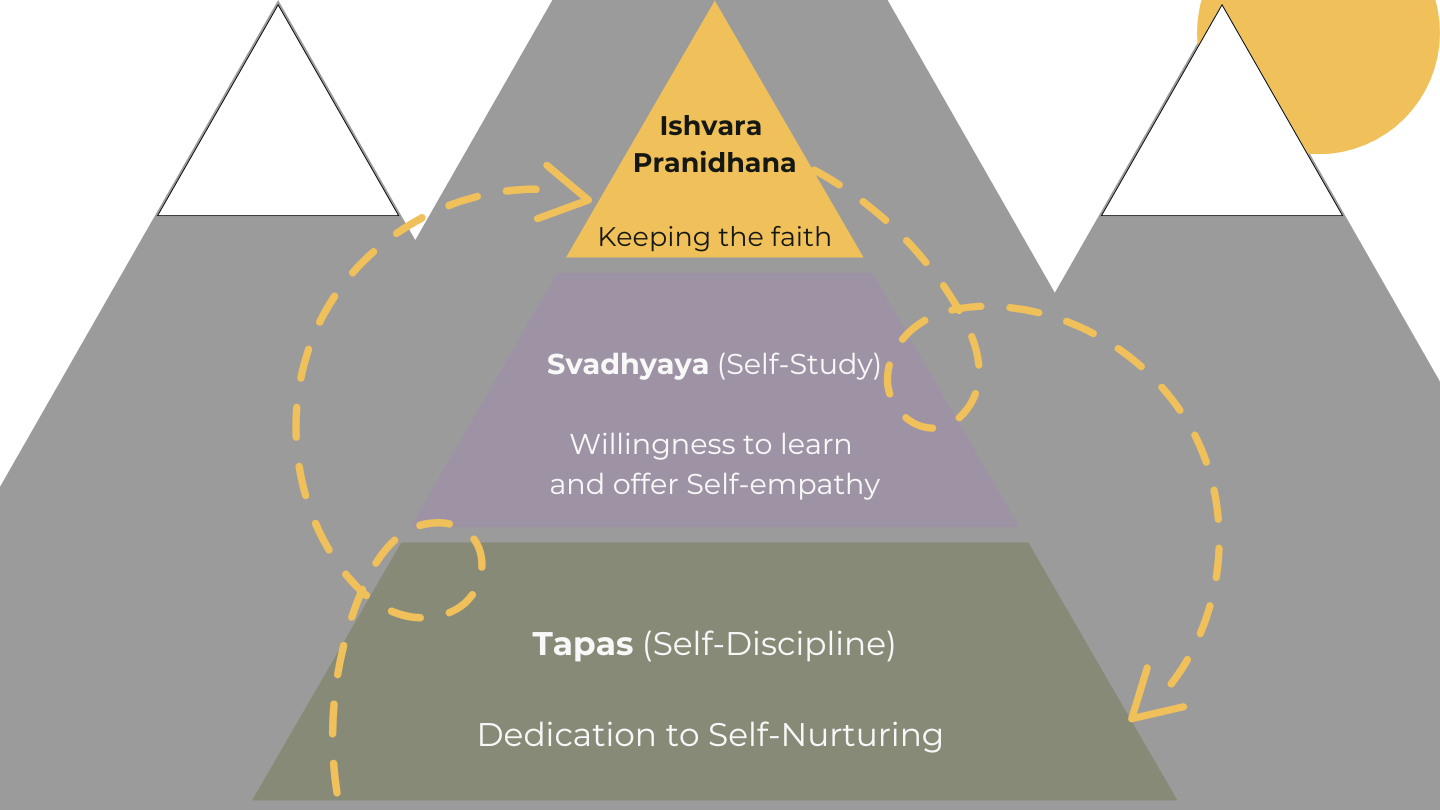
In yoga, we call this Tapas. In Sanskrit, Tapas root meaning is “to heat” or “to burn.” Think of it like a flame under a pot of water, transforming liquid into steam.
It’s also the fire of self-discipline—a commitment to choices that truly support your well-being. Not because society says you should, but because they align with your values and needs.
And so, you take a breath and a step.
Your spark catches flame.
Your journey begins.
And your Tapas becomes the fire that fuels your transformation and lights the path ahead.
Why Is Sticking With It So Hard?
Maybe you’ve noticed a pattern: Every time you try something new, something good for you, you eventually slip back into old ways, lose motivation, or give up entirely.
This is where the next Niyama (personal practice) comes in: Svadhyaya—self-study and self-empathy.
In yoga therapy, Svadhyaya helps us discover the tools and allies we need to navigate our greatest challenges. It also explains why other people’s paths or programs haven’t worked for you—because your path is uniquely yours, as is your pace.
On any journey, we’ll wander off-trail. We’ll take detours and side quests —some intentional, some accidental. These moments aren’t failures and they aren’t proof that we’re weak or incapable.
They are opportunities to learn, to practice self-empathy, and to adjust course.
There is so much freedom in receiving our missteps with grace. Instead of thinking, I’m not disciplined. I suck. I’ll never change, we can ask:
- What beliefs am I holding onto about this or myself?
- Why do I believe they’re true?
- What new beliefs would help me grow?
- What deeper need is underneath this habit?
Like building a fire, the beginning requires effort. But with consistency, the fire sustains itself, illuminating the tools and allies you need to succeed.
The Final Step: Faith and Surrender
At the peak of the mountain, we find the final Niyama: Ishvara Pranidhana—faith and surrender. Belief in ourself and the world around us.
Iceland, consistently ranked among the happiest countries with the highest quality of life, has a saying: "Petta reddast." It translates to, "It will all work out."
Surrender is available to you now. You don’t have to wait until you’ve “arrived” to trust the process. You can imagine this faith ever-cascading down from the top encompassing the entire mountain and you, always.
This practice reminds us to release the need to control how everything unfolds. To let go of what no longer serves us. To connect with the path as the destination—because you are already exactly where you’re meant to be.
Your Choice: Turn Back or Step Forward
Every hero’s journey has a moment of choice: Do they stay with the discomfort they know? Or do they step forward into the unknown?
Maybe you’ve felt it—that quiet nudge to start taking better care of yourself. To move your body more. To shift a mindset that no longer serves you.
And maybe you’ve ignored it, telling yourself you’ll start when life slows down… when you have more energy… when it feels easier.
But here’s the truth:
Your journey to well-being will either be one you choose—or one that’s chosen for you through burnout and dis-ease.
The real question is:
Will you employ the courage to take the journey to the Self, through the self, and return with greater wisdom and freedom?
The answers aren’t out there. The answers are within you.
The Guide Appears
In a classic hero’s journey, a guide appears to help you navigate the journey. Think Yoda, Master Splinter (teenage mutant ninja turtle) or Ana to Elsa in Disney's tale, Frozen.
We all deserve to be seen and to feel supported and encouraged along the path. If you’re looking for guidance to help you through pain, anxiety or life changes, I’m here to support you and help you pave your unique path using yoga's tools and philosophy.
If you’ve ever struggled with follow-through, doubted your ability to change, or wondered what makes this different—I see you.
Read more on how yoga therapy creates lasting transformation in the after-blog below.
Thanks for reading. I’d love to hear your comments and questions. Please email me at: mandy@homeandyoga.com
P.S. Whenever you're ready, Home Yoga Therapy can help you in 3 ways:
- Join the Home + Yoga Community 3 live online yoga classes each week, access to library of recorded practices, ALIGN Moon Rituals, and personalized support.
- Yoga Therapy thoughtful discussions and mindful practices that foster change, balance, and well-being in body, mind, and spirit.
- Subscribe to Newsletter Join Mandy's email list below and get updates on new blog articles and upcoming events.
The after-blog: Yoga as the Missing Link in Transformation
If you’ve ever struggled with following through on change, it might not be about willpower—it might be about your nervous system, self-trust, and approach to transformation. Yoga therapy offers a sustainable, compassionate path that allows you to shift from frustration to flow.
How Yoga Therapy Helps You Build Lasting Change:
1. Regulate Your Nervous System
When stress or self-doubt kicks in, your nervous system may default to fight, flight, or freeze. Yoga therapy integrates breathwork, movement, and mindfulness to create a sense of safety, making it easier to follow through.
2. Shift Mindset from Discipline to Trust
Instead of forcing habits or change, yoga therapy helps you trust yourself through awareness and self-compassion. When you listen to your body and adjust accordingly, change becomes more natural and enjoyable.
3. Move Past Resistance
Resistance isn’t a sign of failure—it’s a sign of misalignment. Through yoga therapy, you learn to observe resistance, work with it, and shift patterns in a sustainable way.
4. Create an Embodied Practice for Self-Trust
Unlike traditional behavior changing modalities (Cognitive Behavioral Therapy (CBT) and habit tracking), yoga therapy doesn’t just exist in your head. By engaging in movement, breath, and stillness, you build trust in yourself through action, making long-term change feel intuitive rather than forced.
Mandy Leman | MAR 14, 2025
Share this blog post